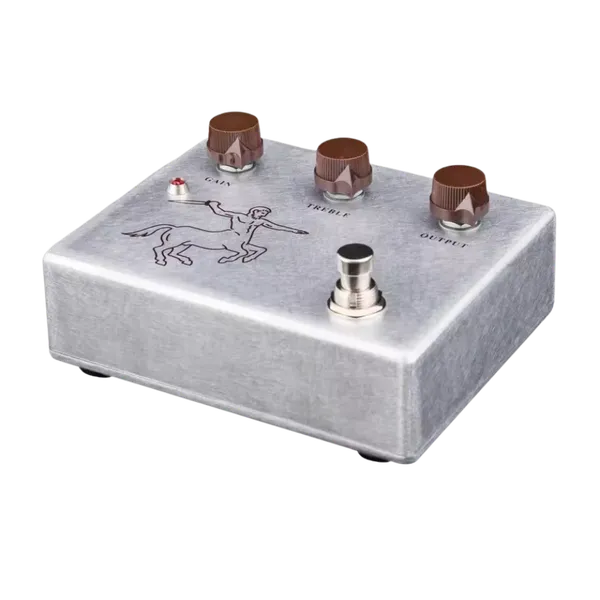
DIY Klon Centaur Clone
Handbuilt Klon Centaur clone, my first DIY pedal build
| Maker | DIY (handbuilt) |
|---|---|
| Model | Klon Centaur |
| Type | Overdrive / boost |
Store
| Store | Price | Checked |
|---|---|---|
| DIY Music Gear | 369kr | 2026-09-20 |
Description
A Klon Centaur overdrive clone that I built myself, and my first pedal build. I heard a lot about this pedal, the Centaur is a classic. It got really famous more recently, after some famous artists started using it, but back when it was created it wasn't that known and it wasn't that famous either.
A bit of the history: Bill Finnegan developed it in Boston with engineers from MIT and released it in 1994, going after the sound of an amp pushed hard instead of another Tube Screamer. He built every single unit by hand, around 8,000 of them until he stopped in 2008, and he covered the boards in black epoxy so nobody could copy the circuit. The secrecy plus the small numbers is basically why the used prices went crazy and the pedal became a legend.
It's an overdrive pedal, so it simulates an amplifier being pushed when you send the volume knob to the maximum. Back then amplifiers were made with valves, so you had that natural degradation of the sound and that natural warm distortion. The clone is an attempt to reproduce that sound, but in a way where the analog signal, differently from other overdrive pedals, still stays in the signal you're distorting. So instead of distorting the whole thing and having no clean original signal left, I have both the clean signal and the overdriven signal on top of each other.
The way it gets there is with a charge pump. Most pedals run the operational amplifier around a 4.5 volt bias, which is half of a 9 volt battery, so it has something to oscillate around. The Klon keeps that bias, but it also has a charge pump that doubles and inverts the supply, so the op amps get +18 volts and -9 volts to work with. That's a lot more headroom, and the distortion comes out better and more natural than the squarer digital distortions we're used to hearing.
The clipping diodes are germanium, 1N34A, two or four of them if I'm not mistaken. Those didn't come with the kit, it shipped with standard clipping diodes, so I swapped them for the germanium ones. They sit in the feedback loop of the second op amp and at moderate gain they barely conduct, so a good part of the character actually comes from the op amp stages and from that blend with the clean signal. Germanium is relatively sensitive to temperature. The build also has a lot of resistors and a lot of capacitors, and all the capacitors are polypropylene.
Impressions
The temperature thing means that depending on the day you're playing it can sound warmer or colder, a bit more digital or a bit less, with a slightly more solid distortion or not. In general that's cool, but when you have to repeat the signal and repeat the sound, it's a nightmare.
The germanium is the only reason I wouldn't give this pedal a 9 point something or a 10. It's hard to predict the sound it's going to have, sometimes it's good, sometimes it's bad, sometimes it doesn't conduct anything and sometimes it conducts a lot, so it depends a lot. Especially here in Sweden, where we get six months of absurd cold and six months of absurd heat.
I think this is an excellent pedal to play, mostly because it doesn't distort the sound that much, but it can distort quite a lot if you push the knobs to the maximum. Right now I use it as my first distortion pedal, right after the compressor and before everything else. If it's on a lighter setting, just as a light overdrive, it's basically acting as a booster. So I can turn on the Klon and the DS-1 together and it works like a volume booster with a little bit of distortion, they go really well together. The only one that doesn't work with it is the Metal Zone, which basically eats every signal that comes before it and gives the same output to everyone.
I also think the enclosure is very beautiful and it was very easy to build, and with those polypropylene capacitors it has a relatively warmer sound.
It's a very versatile pedal and I like it a lot. What I want to do at some point is recreate this build with all the original components, if I can manage to find them.
Final thoughts
I think this is a pedal every guitar player should have at least once, or at least try once, even if you have to build your own or buy one already made. Today it's probably the most cloned pedal in history, which is a funny irony considering that Klon literally means clone.
It's a sound everyone should hear at some point in their life and try to understand how it works, because it says a lot about how pedals, guitars and electric instruments work in general. There's a lot more to it than that thick and direct distortion we're used to from metal and rock. It's a much more winding thing, full of small details, with way more variation than the basics.