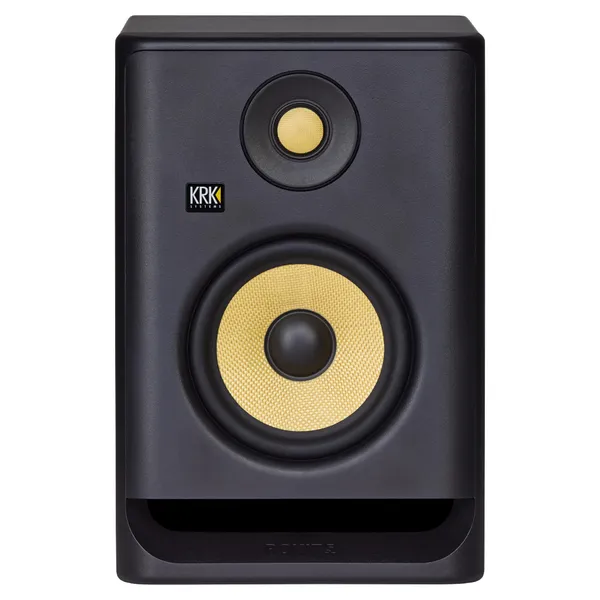
KRK Rokit 5
5-inch bi-amplified near-field studio monitor with onboard DSP room EQ. Use it as my main monitor and audio out on the work setup. The sound is amazing and also has a super high fidelity audio.
| Maker | KRK Systems |
|---|---|
| Model | RP5 Rokit 5 G4 |
| Type | Active 2-way near-field studio monitor (5" woofer, 1" tweeter, 55 W class D) |
Store
| Store | Price | Checked |
|---|---|---|
| PriceRunner.se | 1 690 kr | 2026-09-21 |
Specs
| Spec | Value |
|---|---|
| Amplifier | 55 W class D (combined) |
| Frequency response | 43 Hz - 40 kHz |
| Input impedance | 5.12 kOhm balanced |
Description
My main monitor and the audio out on the work setup. I'm very happy with how it sounds.
I bought them together with the Scarlett, because I really wanted to record music, record myself playing and practising. My musician friend recommended I get a monitor, and at the time he lent me two small Creative speakers, the same brand as the Pebbles but a different model. They did a very good job for how small they are, but they weren't completely flat, so the sound coming out of them was quite different from what I heard on my headphones, which back then were the AKG. After I bought the Beyerdynamics that difference got even bigger, and that was the trigger to buy these monitors.
When you're recording a song and doing music production, I won't say professional, but music production properly speaking, you want the sound you hear to be as faithful as possible to the sound people on the other side, on Spotify or literally anywhere, are going to hear when they download and play your song. That kind of speaker only exists as a studio monitor. Studio monitors like the KRK are built to be flat, meaning the EQ gets as close as possible to a neutral wave, with no gain on the lows, the mids or the highs, and you can adjust them to the room you're in.
Impressions
These are probably one of the best speakers I've ever had. Probably the best speaker I've ever had. I was never one for listening to music very loud, or for having absurd speakers, not even growing up in the 2000s, which was kind of the peak of that whole thing of having sound systems with CDs and super hyper mega speakers. So I never had that love for speakers until I bought this guy.
I couldn't find a used set anywhere, so I ended up looking at the price of new ones and saw they weren't that expensive, and this isn't their latest generation either. I thought about buying the RP8, which is bigger than the RP5, but then I saw that the only real difference is the volume and the amount of sound they produce, so it doesn't make that much difference.
I've been very happy with them. They're relatively expensive, you have to buy the two separately, and ideally you put them on stands. I ended up setting them the same way I set the Argons in the audio room, on a piece of foam that tilts them slightly up, about 15 degrees if I'm not mistaken.
Along the way I learned a ton of things about listening to music the best possible way. KRK have their own app full of things for setting up your monitors and reading the room. Getting the monitors right in the room and fitting them properly was another odyssey that took a few hours, because I had to measure the room frequency and run tests with white noise and pink noise. I didn't even know there were that many colours of noise. So it was a big process, not just of knowledge but of learning along the way.
Today I clearly feel the difference between listening to music on these and on any of the other amplifiers I have at home, and there are a few. I have a Sony soundbar that I use mostly for television and films, and the difference between listening to music on the KRKs and on that is absurdly clear, it has its own EQ and it isn't the same thing. The Argons are much closer to the KRK, because they're also built for a higher definition and more neutral curve.
The one problem is that they don't have any output other than XLR. Each speaker is individual, each one has its own amplifier, its own power input and its own audio input, so they work like two standalone speakers, each connected to a separate channel of your stereo. I connect one of them with an XLR to RCA cable into the left channel of the Scarlett and the other one into the right. In the future all of this is going to change, because I'm going to connect each one to a channel of the Behringer and run the Scarlett output into the Behringer input, so I can control each side individually and also connect several other things.
Final thoughts
I recommend these a lot, not just for anyone doing studio monitoring but for anyone doing anything else.
That said, if you're only using them to listen to music, I'd say it's a relatively expensive price for a speaker with so few features, because you can pay the same for speakers that are actually made for listening to music and don't need a curve as flat as these.