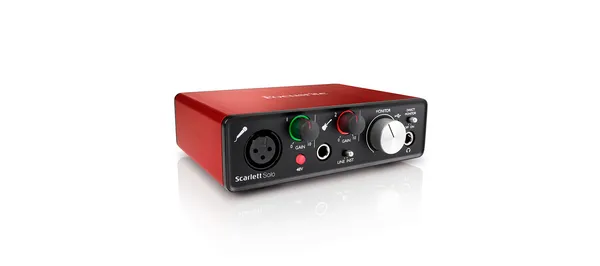
Focusrite Scarlett Solo 2nd Gen
2-in / 2-out bus-powered USB audio interface with one mic preamp and one instrument input. Old and discontinued, but works for what I do.
| Maker | Focusrite |
|---|---|
| Model | Scarlett Solo (2nd Gen) |
| Type | 2-in / 2-out USB 2.0 audio interface (24-bit / 192 kHz, 1 mic + 1 instrument input) |
Store
| Store | Price | Checked |
|---|---|---|
| Tradera (used) | 500 kr | 2026-09-21 |
Specs
| Spec | Value |
|---|---|
| Input 1 | Balanced XLR mic, 48 V phantom power switch |
| Input 2 | 1/4" TRS jack, switchable instrument (unbalanced) / line (balanced) |
Description
My audio interface, used together with the Xenyx. It's old and discontinued, but it works for what I do.
This was my entry into the world of music and music production. I have a friend who is an excellent musician and he has the same Scarlett, only the 4th gen instead of the 2nd. I didn't know whether I'd like music production or not, so I ended up buying this one used for a super cheap price.
It has two inputs, one for a microphone and one for an instrument, a direct monitor, and its own volume controls. The back has a USB type B, the fat one, and the only outputs are RCA. I run it through my monitor, which also works as a hub, and from there to the Mac over USB-C.
Impressions
I liked it a lot. It's a super interesting audio interface and it has everything I need, and as I've said before, I really like analog knobs for things.
It isn't the best thing in the world though, mostly because of that USB type B on the back. That connector doesn't make much contact with the socket, so it ends up with a bad connection, and when my cats walk behind it I get pops in the speakers, which in this case are the KRKs. Having only RCA out is limiting too, there's no TRS or XLR on the back.
The other limitation, and this is true of every Scarlett Solo, is the headphone volume. I can plug headphones in, but I can't control their volume separately from the instrument volume, it's all one channel. That gets in my way every now and then, because everything is connected to it, the speakers included. When I'm having a music lesson, or playing something and talking to someone at the same time, I can't separate the two, I can't send the instrument audio and hear the person at the same time. That's exactly why I bought the Behringer.
Final thoughts
It's very good for someone getting into music, but I wouldn't recommend buying the 2nd gen specifically, the one I have. It's pretty basic and the line is already on the 4th or 5th generation. If you're going for an older one, buy the Scarlett 2i2, which is a bit better and has more inputs and outputs, or just go straight for a 4th gen.
I don't see any reason to replace mine, I don't do absurd recordings or anything like that. If I ever do swap it for something else, I'll probably buy a better multi-effects unit with a DSP instead, not a Quad Cortex, but maybe a Nano Cortex, or a Hotone Ampero to use as the interface, since it ends up being the same thing.